
Cognitive Behavioral Therapy Online


Cognitive behavioral therapy (CBT) is one of the most widely used and researched forms of psychotherapy. It focuses on helping people understand how thoughts, emotions, and behaviors are connected, and how changing certain patterns can improve mental health.
Online CBT uses the same evidence-based principles as traditional therapy while allowing you to work through exercises, reflections, and guidance digitally. With structured tools and therapist support, many people find that online CBT helps them better understand their challenges and develop practical strategies for managing them.
Checkout the video where Dr. Elizabeth Lombardo, PhD, will tell you about the basics of CBT and how it works.

Contents
- What is cognitive behavioral therapy?
- Does online CBT work?
- How online CBT works
- Common CBT tools and techniques
- What to expect from CBT online
- Frequently asked questions
What is cognitive behavioral therapy?
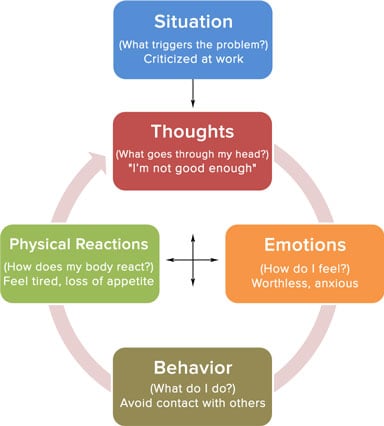
Since CBT constitutes the foundation of our online therapy program, it is helpful to understand the basic idea behind it.
Cognitive: Refers to thoughts and mental processes such as thinking, understanding, learning, and remembering.
Behavioral: Refers to actions and responses to situations, including both what we do and what we avoid doing.
CBT is based on the idea that thoughts influence emotions and behaviors. In many situations it is not the event itself that causes distress, but rather how the event is interpreted.
Because of this, learning to identify and evaluate thoughts can help people respond to situations in more balanced ways. When thinking patterns change, emotions and behaviors often change as well.
Does online CBT work?
Research suggests that online CBT can be as effective as traditional face-to-face therapy for many common mental health concerns.
Our online therapy program is based on CBT principles and provides structured tools, educational material, and therapist guidance designed to help people understand and work through their challenges.
Thousands of users have used our program to work on issues such as anxiety, stress, depression, and relationship challenges with an average rating of 4.8 out of 5 stars (based on 5007 reviews).

How online CBT works
CBT is a structured and practical approach that focuses on identifying specific problems and working through them step by step.
-
It helps you to identify and challenge your specific problems
CBT is a problem-specific and pragmatic approach since it helps you to identify your specific problems and then gives you therapeutic tools so that you can overcome those problems. CBT differs from many other therapies by having a clear predetermined structure, rather than the person talking/thinking freely about whatever comes to mind. Compared to traditional therapy, it also focuses on what is happening in your life here and now, rather than exploring what happened in the past.
-
It teaches you to think in a different way
CBT is particularly well developed and empirically supported in cases where clients frequently experience excessively negative thoughts that arise automatically, even in response to stimuli that might otherwise be experienced as positive. CBT helps you understand the importance of thinking and how it affects how you feel and what you do. This very much includes learning to record your thoughts and looking at them more realistically.
-
It helps you to unlearn unwanted reactions
CBT is based on the scientifically supported assumption that most emotional and behavioral reactions are learned. Therefore, the goal of the therapy is to help you unlearn your unwanted reactions and to learn a new way of reacting.
-
Supports you with hands-on tools
Each of the eight sections in our program is comprised of video (guided by Dr. Elizabeth Lombardo, PhD), audio, reading material and practical activities. You will use worksheets, create your own activity plan and start keeping a journal. These are very important parts of CBT and will give you and your therapist the foundation to work from in overcoming your problems. If you thoroughly complete all of these activities, we guarantee that you will make the most of our program and get the best results. These tools will make you look at and think about problems and situations in a different way.
-
It provides long-term results
The educational emphasis of CBT has an additional benefit in that it leads to long-term results. When people understand how and why they are doing well, they know what to do to continue doing well. Everything you learn from our program can be used over and over again. Your therapist will show you how you can stay in control of your problems and manage your own recovery on a long-term basis.
Common CBT tools and techniques
Online CBT programs often include a variety of structured tools designed to help people practice the principles of cognitive behavioral therapy.
- Thought records – exercises that help identify and evaluate automatic thoughts
- Journaling – tracking emotions and situations to understand patterns
- Behavioral activation – planning positive activities that support mood and motivation
- Exposure exercises – gradually approaching situations that previously caused anxiety
- Reflection worksheets – structured exercises used to practice CBT skills
These tools are commonly used within CBT programs and are designed to help people apply therapeutic concepts in everyday life.
What to expect from CBT online
Online CBT programs typically combine educational material with practical exercises and therapist guidance.
In our program, the CBT course includes multiple sections featuring video lessons, written material, exercises, and reflection activities. These materials help you understand the CBT model and practice applying it to situations in your life.
Worksheets, journaling exercises, and activity planning are important parts of the process. They provide a structured way for you and your therapist to track progress and identify helpful changes.
The goal of CBT is not only to address current challenges but also to develop skills that can be used long term.
Frequently asked questions
What problems can CBT help with?
CBT is commonly used to address a wide range of mental health concerns including anxiety, depression, stress, panic attacks, and relationship difficulties.
How long does CBT usually take?
CBT is generally structured and time-limited compared with many other forms of therapy. The exact length varies depending on individual goals and circumstances.
Is online CBT different from face-to-face therapy?
The underlying principles are the same. The main difference is that online CBT uses digital tools, messaging, and exercises to deliver the therapy process.
Do I still work with a therapist?
Yes. Online CBT programs often combine structured material with therapist guidance to help you apply CBT concepts effectively.
Start CBT online today
If you would like to begin working through CBT exercises with therapist support, you can get started today.
Resources:
Clinical Effectiveness of Internet-Based Cognitive Behavioral Therapy for Insomnia in Routine Secondary Care: Results of a Randomized Controlled Trial »
This 2024 study from Frontiers in Psychiatry supports the use of internet-based CBT for treating insomnia, showing significant improvements in sleep outcomes.
Internet-Based and Mobile-Based Cognitive Behavioral Therapy for Chronic Diseases: A Systematic Review and Meta-Analysis »
This 2024 meta-analysis in NPJ Digital Medicine highlights the effectiveness of internet-based CBT for managing psychiatric symptoms and physical distress in patients with chronic diseases.
Internet-supported versus face-to-face cognitive behavior therapy for depression »
This study compares the effectiveness of internet-supported CBT with traditional face-to-face therapy for treating depression, finding comparable outcomes.
Long-term effects of internet-supported cognitive behaviour therapy »
This research examines the long-term benefits of internet-supported CBT, highlighting its sustained effectiveness over time.
Cognitive behavior therapy via the Internet: a systematic review of applications, clinical efficacy and cost–effectiveness »
This systematic review discusses the applications, clinical efficacy, and cost-effectiveness of internet-based CBT, supporting its broader use in mental health care.
Internet-Based Treatment of Depression: A Randomized Controlled Trial Comparing Guided with Unguided Self-Help »
This randomized controlled trial compares guided and unguided internet-based CBT for depression, finding that guidance enhances treatment outcomes.
Internet-Based and Other Computerized Psychological Treatments for Adult Depression: A Meta-Analysis »
This meta-analysis evaluates the effectiveness of internet-based and other computerized psychological treatments for adult depression, confirming their efficacy.
Internet-based psychological treatments for depression »
This review discusses the various internet-based psychological treatments available for depression, emphasizing their potential as effective treatment options.
Internet-based vs. face-to-face cognitive behavior therapy for psychiatric and somatic disorders: an updated systematic review and meta-analysis »
This updated systematic review and meta-analysis compares internet-based CBT with face-to-face therapy for various psychiatric and somatic disorders, finding similar effectiveness.
Internet-delivered transdiagnostic and tailored cognitive behavioral therapy for anxiety and depression: a systematic review and meta-analysis of randomized controlled trials »
This systematic review and meta-analysis focuses on the efficacy of internet-delivered transdiagnostic and tailored CBT for treating anxiety and depression.